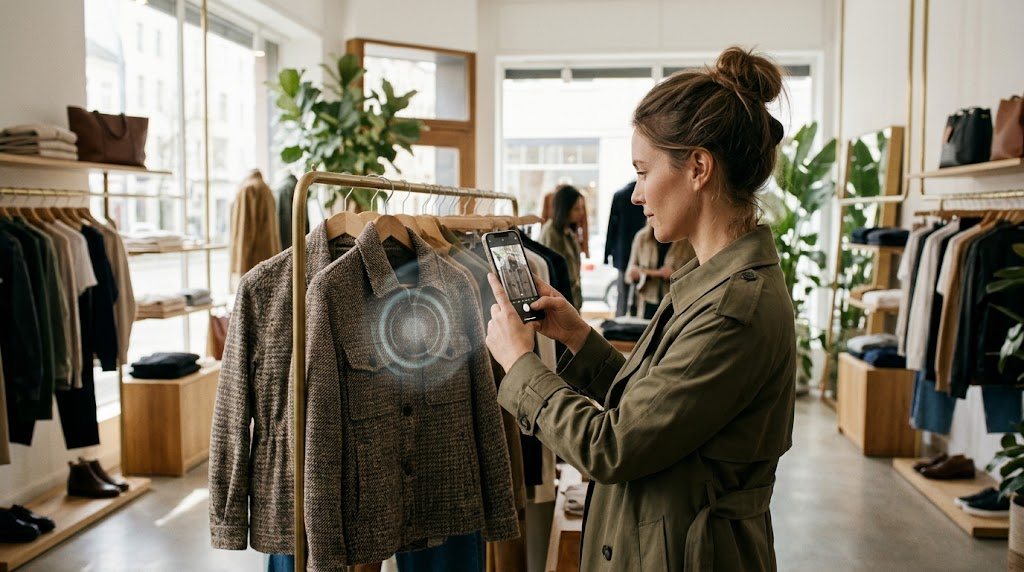
Shoppers can now search with a camera and try on clothes with a selfie. Here is how visual search and AI imagery are making online shopping more personal and how brands can shine.
Some of the best shopping moments start with a picture, not a keyword. A jacket on a stranger, a lamp in a cafe, a pair of sneakers in a friend's photo. Shoppers have always known what they love when they see it. Now their phones can find it for them.
Visual search, virtual try-on and AI-generated product imagery are making online shopping more personal and more confident. Together they help shoppers find the right item faster and help brands show their products at their best.
The camera becomes a search box
Google Lens has grown into one of the most popular ways to search. In October 2024, Google said Lens handled nearly 20 billion visual searches every month, and that 20% of them were related to shopping. At Google I/O in May 2025, CEO Sundar Pichai said Lens usage had grown 65% year over year, with more than 100 billion visual searches already that year.
The shopping experience inside Lens has grown richer as well. When Lens recognizes a product in a photo, it can show prices across retailers, current deals, reviews and where to buy. Circle to Search on select Android phones lets people circle or tap a product on their screen to find similar options.
Shoppers can also combine a photo with words. Snap a picture of a couch and add "velvet" or "brown," and the results adjust to match. It is the digital version of telling a store associate, "like this, but in green."
Visual search is especially helpful in categories such as toys, electronics and beauty, where seeing the exact item matters a great deal. Each search draws on Google's Shopping Graph, which by November 2025 held more than 50 billion product listings, with 2 billion refreshed every hour. That freshness means a photo can lead to a product that is in stock today.
Why visual search fits how people shop
- It captures inspiration instantly. No need to guess the name of a style or a brand.
- It handles hard-to-describe items. Patterns, shapes and textures are easier to show than to type.
- It connects the physical and digital. A product seen on the street can be in a cart within seconds.
- It surfaces alternatives. Similar items at different styles and price points widen the choice.
Virtual try-on brings the fitting room home
Apparel has always been the category where online shoppers hesitate most. Will it look right on me? Virtual try-on answers that question directly. In July 2025, Google launched its try-on feature for shoppers in the United States: upload a full-length photo of yourself, tap "try it on" on a shirt, dress or pair of pants, and AI shows how the piece would look on you.
Shoppers can save favorite looks, revisit past try-ons and share them with friends for a second opinion. The feature works across Search, Google Shopping and product results in Google Images. Alongside it, Google added price tracking for clothing that lets shoppers choose their preferred size and color and receive an alert when the item hits their target.
Personalization that feels like a good stylist
The thread connecting these tools is personalization. Instead of showing every shopper the same grid of products, AI can respond to an individual's photo, words and preferences. The result feels closer to a conversation with a knowledgeable stylist than to browsing a catalog.
That matters because confidence drives purchase. A shopper who has seen an outfit on their own body, or found the exact lamp they spotted in a cafe, arrives at checkout with fewer doubts. Personalized discovery also introduces shoppers to brands they did not know to search for by name, which is good news for smaller and newer labels.
Personalization also works across moments. A shopper might start with a photo in Lens, refine the idea in a conversation with an AI assistant, try the piece on with a selfie and set a price alert in their size. Each step builds on the last, so the experience feels like one continuous visit rather than a series of separate searches. For brands, every one of those steps is another chance to be discovered.
Categories where visual discovery shines
Visual tools help most where style and fit drive the decision:
- Fashion and accessories: finding a look and seeing it on yourself before you buy.
- Home and furniture: matching a sofa, rug or lamp to a room you love.
- Beauty: identifying a product spotted in a video or a friend's bathroom.
- Toys and gifts: tracking down the exact item a child pointed to.
AI product imagery helps every brand look its best
Great visual discovery depends on great visuals. Google introduced Product Studio in May 2023 to help merchants create product imagery with generative AI from inside Merchant Center. Merchants can:
- Create new scenes: place a product in a seasonal or lifestyle setting without a new photo shoot.
- Remove backgrounds: produce clean, consistent images for a catalog.
- Increase resolution: sharpen small or low-quality images so products look crisp.
Google's own data showed why this matters: product offers with more than one image saw 76% more impressions and 32% more clicks. More and better images give both shoppers and search systems more to work with.
Generative imagery also makes it easier to test ideas. A brand can show the same product in a beach scene for summer and a cozy living room for winter, then keep the version shoppers respond to. Smaller brands, in particular, gain access to visuals that once required a studio and a full production day.
How retailers can shine in visual search
Visual discovery rewards brands that treat imagery as core product data. A few steps help products appear when shoppers search with a camera:
- Show products from several angles. Front, side, detail and in-use shots give visual systems more to match.
- Include lifestyle images. Products shown in real settings connect with the scenes shoppers photograph.
- Keep listings complete. Accurate color, material, size and pattern attributes help AI connect an image to the right item.
- Use models with a range of body types. It helps shoppers picture themselves in the product and supports try-on experiences.
- Refresh imagery for seasons. AI scene tools make it simple to keep visuals current.
Making your catalog easy to see and try
Shoppers increasingly start with what they see, and AI is getting very good at turning that spark into a match. Visual search, try-on and AI imagery all point the same way: the brands with rich, accurate and attractive visuals will be easiest to find and easiest to love.
A simple next step is to audit your ten best-selling products. Count the images, check the angles and confirm the attributes are complete. Then use an AI imagery tool to add one lifestyle scene to each. It is a modest effort that helps your products show up the moment a shopper points a camera at something they love.
Sources
- Google, The Keyword: "3 ways visual search helps you shop," October 3, 2024.
- TechCrunch: "Sundar Pichai shares some Google Lens stats," May 20, 2025.
- Android Central: "Go shopping with Google's virtual AI 'Try On' as it launches for US users in Search," July 24, 2025.
- Google, The Keyword: "New tools to help small businesses connect with online shoppers," May 23, 2023.
- Google, The Keyword: "Let AI do the hard parts of your holiday shopping," November 13, 2025.